
Ark Invest Researcher Doubts Open USD Can Beat Circle After 16% Stock Drop


Key Takeaways
- Circle shares fell 16.5% on June 30, 2026, after Open Standard unveiled the OUSD stablecoin.
- Coinbase and Blackrock are among 140 backers of OUSD, pressuring Circle’s USDC reserve income.
- Circle’s Coinbase distribution deal renews in August as OUSD targets a launch later in 2026.
The stock CRCL closed down approximately 16.5%, trading as low as $63.10 after opening near $72.46. The prior close on June 29 was $75.96. The drop marks one of the sharpest single-day declines since Circle’s listing and extends a pullback from earlier 2026 highs near $129. CRCL has also shed more than 40% over the last 30 days, according to logged data.
A Stablecoin Built to Undercut Circle
The new token, reported on by Bitcoin.com News earlier in the day, called Open USD or OUSD, comes from an independent entity named Open Standard. It charges no mint or redeem fees, sets no volume caps, and shares reserve yields with partners. A partner board governs the project instead of a single issuer.
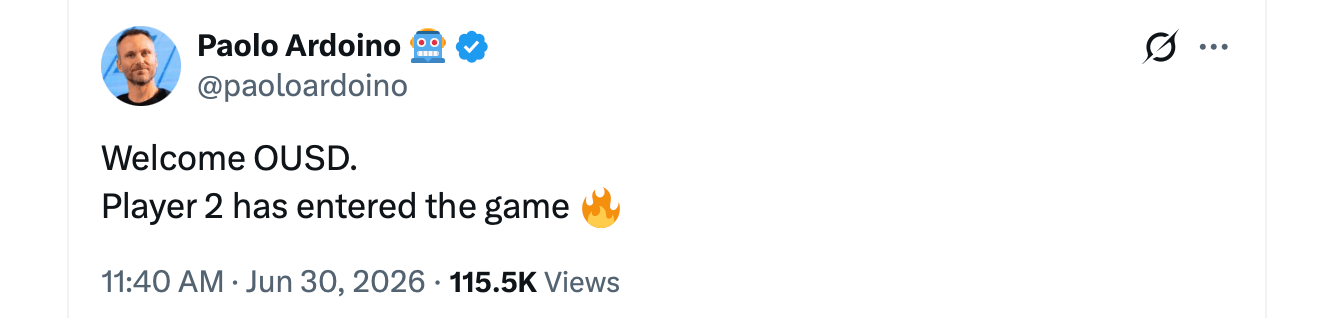
Zach Abrams, co-founder of Bridge, the payments company Stripe acquired, leads the effort on an interim basis. Backers span payments networks, banks and crypto firms, including BNY Mellon, U.S. Bank, Ripple, Google, and Shopify. OUSD is expected to go live later in 2026 on chains including Solana, Stellar, Base, and Polygon.
Why Circle’s Business Model Is Exposed
Circle earns most of its revenue from interest on the Treasuries backing USDC reserves, a roughly $73 billion to $74 billion stablecoin. OUSD pushes that yield back to partners instead of keeping it for the issuer. That structure removes the economic reason many businesses tolerate Circle’s fees.
Coinbase’s role stands out. Circle paid Coinbase close to $908 million in 2024 for USDC distribution, and that revenue-sharing agreement renews in August. Coinbase backing a yield-sharing rival adds pressure to that negotiation.
Skepticism From Wall Street
Lorenzo Valente, Director of Digital Asset Research at Ark Invest, called the announcement a familiar pattern. He pointed to past consortium attempts like Diem and the Global Dollar Network and said a board representing 500 competing firms moves too slowly to challenge issuers that can ship products on their own.
Valente also questioned the funding model. He estimated that at $10 billion in supply and a 25 basis point share, Open Standard would generate around $25 million a year, far short of what it costs to fund partner rebates and settlement infrastructure. “I’d bet on the two operators who can ship unilaterally over a committee that has to ask 500 rivals for permission,” he said on X.
What Comes Next
USDC still holds advantages in liquidity, regulatory standing, and existing exchange integrations. New stablecoins have historically struggled to win meaningful market share quickly, and OUSD is not live yet.
Circle has not issued a detailed public response. CEO Jeremy Allaire has previously pointed to USDC’s reliability and established position when competitors have entered the market.
The stablecoin sector overall has grown past $300 billion, with USDT near $184 billion and USDC near $74 billion. Citi has projected the broader market could reach $4 trillion by 2030, a backdrop that explains why payments giants and banks are willing to back a structurally different model even before it launches.
Traders watching Circle stock will likely focus on the August renewal of the Coinbase distribution deal and any public comments from Circle as OUSD moves toward launch.

140 Firms Including Coinbase and Ripple Launch the New Open USD Stablecoin
Visa, Coinbase, Stripe, Mastercard and more than 140 other companies are launching a new stablecoin called Open USD, built to…


140 Firms Including Coinbase and Ripple Launch the New Open USD Stablecoin
Visa, Coinbase, Stripe, Mastercard and more than 140 other companies are launching a new stablecoin called Open USD, built to…
140 Firms Including Coinbase and Ripple Launch the New Open USD Stablecoin
Visa, Coinbase, Stripe, Mastercard and more than 140 other companies are launching a new stablecoin called Open USD, built to…



