
Wall Street’s Bitcoin bears quietly retreated despite recent plunge toward $80,000


Hedge funds cut their net bearish Bitcoin futures bets nearly 15% even as the cryptocurrency tumbled toward $80,000.
Data from the Commodity Futures Trading Commission (CFTC) showed leveraged funds held a net short position equivalent to 30,611 BTC as of Oct. 13, down from 35,903 BTC a week earlier.
The 5,292 BTC reduction came as Bitcoin fell nearly 3% during the reporting period, from about $85,600 on Oct. 6 to $83,100 on Oct. 13. The cryptocurrency briefly slipped below $81,000 as rising Treasury yields, weakening institutional demand, and a global technology stock selloff weighed on risk appetite.
The decline gave bearish traders opportunities to take profits, while repeated price reversals increased the risk of holding leveraged positions.
CFTC figures showed that outright short positions declined by 6,437 BTC to 59,458 BTC, compared with a smaller reduction of 1,145 BTC in outright longs to 28,847 BTC.
The faster decline in shorts narrowed the bearish imbalance, although leveraged funds maintained more than twice as much outright short exposure as long exposure.
Bitcoin’s decline exposes traders to mounting market pressure
Bitcoin’s weakness accelerated on Oct. 7 as Treasury yields approached 5.3% and expectations of additional Federal Reserve tightening weighed on speculative assets.
Elevated oil prices reinforced concerns about persistent inflation, while higher bond yields increased the relative appeal of interest-bearing investments.
The cryptocurrency subsequently fell below $81,000 on Oct. 8, extending a retreat from levels near $87,000 earlier in the month. The decline weakened confidence in Bitcoin’s late-September recovery, particularly as demand through US-listed exchange-traded funds deteriorated.
Market volatility intensified again on Oct. 13 as a sharp selloff in South Korean semiconductor stocks spread through Asian equities.
As CryptoSlate reported, South Korea’s KOSPI plunged about 5.5%, with Samsung Electronics and SK Hynix suffering heavy losses amid concerns about the financing and profitability of artificial intelligence investments.
The selloff coincided with approximately $813 million in cryptocurrency liquidations over 24 hours, including $686.72 million in bullish positions. Bitcoin briefly fell below $81,000 before rebounding above $83,000.
The resulting price swings made large directional positions increasingly risky, giving leveraged funds an economic incentive to reduce exposure even as Bitcoin remained under pressure.
Hedge funds increase spread positions by 48% as futures exposure contracts
While leveraged funds reduced outright bearish exposure, they increased positions involving offsetting long and short Bitcoin futures contracts.

CFTC data showed spreading positions rose by 2,719 BTC-equivalent per leg to about 8,434 BTC, up nearly 48% during the reporting week.
Such strategies can involve buying futures contracts with one expiration date while selling contracts expiring in another month, allowing traders to seek returns from differences in futures pricing while limiting directional exposure.
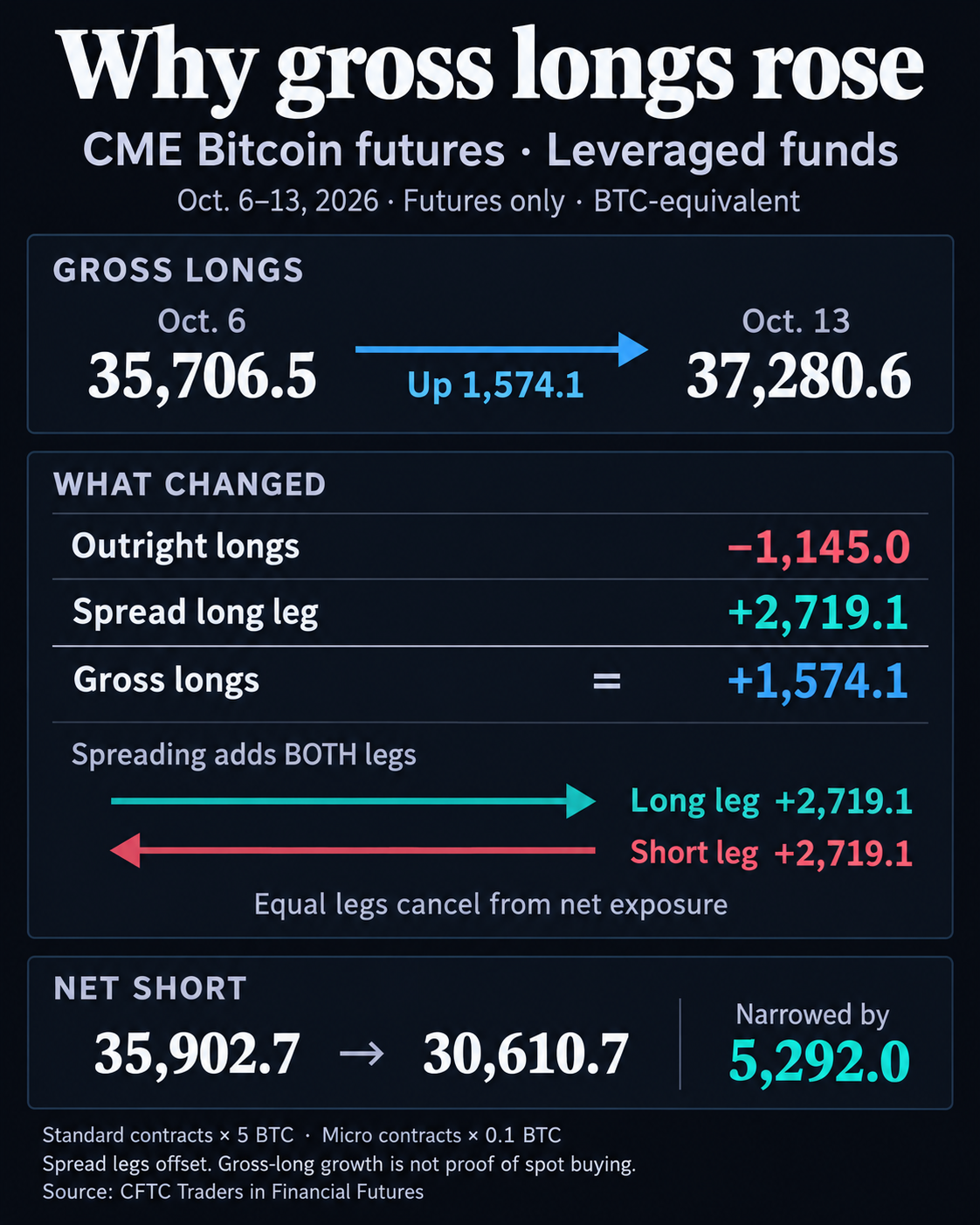
The increase lifted gross long exposure by 1,574 BTC to approximately 37,281 BTC, even though outright bullish positions declined.
Gross short exposure, meanwhile, fell by 3,718 BTC to 67,891 BTC as increased spreading activity partly offset the reduction in directional shorts.
The change coincided with a broader contraction in participation in CME Bitcoin futures. Combined open interest across standard and micro Bitcoin contracts declined by approximately 3,567 BTC-equivalent, or 3.2%, during the week.
Together, the figures show leveraged funds reducing outright market exposure while committing more capital to offsetting futures positions.
Asset managers maintained a contrasting profile, holding approximately 18,440 BTC-equivalent in net long positions. Their bullish imbalance rose by roughly 547 BTC, mainly because short holdings fell faster than long positions.
However, Bitcoin’s subsequent performance complicated the outlook for both groups.
On Oct. 14, hotter-than-expected US consumer inflation revived expectations of another Federal Reserve rate increase, sending Bitcoin below $83,000.
The following day, a sharp increase in wholesale inflation pushed the cryptocurrency to approximately $79,730 and triggered $939 million in cryptocurrency liquidations.
Bitcoin later recovered to about $82,800 on Oct. 19, though the market remained vulnerable to further selling. CryptoSlate reported that Glassnode identified a significant concentration of buying interest near $80,000, with the next major support around $78,000 if that level fails.
Those movements occurred after the latest CFTC positioning snapshot, raising questions about whether leveraged funds continued reducing bearish exposure or rebuilt short positions during the renewed selloff.
The next CFTC report, scheduled for Oct. 23 and covering positions as of Oct. 20, will offer the first indication of how hedge funds responded to Bitcoin’s latest inflation-driven decline and whether the earlier reduction in bearish bets continued as the cryptocurrency struggled to establish support above $80,000.




